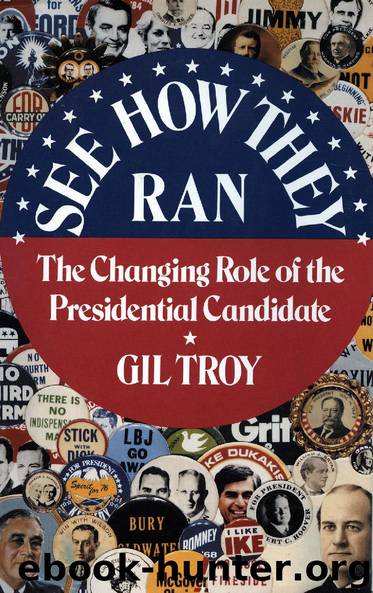
See How They Ran by Gil Troy
Author:Gil Troy
Language: eng
Format: epub
Publisher: Free Press
IV
“Is there anyplace we could go, Mr. President, to find out about your fourth term intentions?” a reporter asked Franklin Roosevelt in June 1944. “My what?” the President chuckled. As long as America remained at war, Roosevelt knew he would have to remain as President. By mid-July, he was ready to announce that although “all that is within me cries out to go back to my home on the Hudson,” if the Democrats nominated him yet again, he would accept. A good soldier, Roosevelt could not “leave his post.” 72
To oppose the President, the Republicans nominated the forty-two-year-old Governor of New York, Thomas E. Dewey. Trim, mustachioed, and energetic, Dewey enjoyed considerable fame from his days as a gang-busting prosecutor. Though somewhat stiff and self-righteous, he demonstrated impressive popular appeal in the presidential primaries. Having drafted him to lead a campaign of youth against the “tired old men” of the New Deal, Republicans fully expected Dewey to stump. Consequently, after conferring with Dewey, his running mate, Governor John W. Bricker of Ohio, announced: “We are going to cover the whole country.” The campaign “will be complete, thorough and aggressive.” This was, Dewey and his men assumed, the natural course. 73
As President Roosevelt prepared to oppose Dewey with his well-practiced Commander in Chief routine, his situation was at the same time easier yet more difficult. After eleven years of the New Deal and three years of the Second World War, Roosevelt’s stature, and that of his office, had grown. Roosevelt had expanded the presidency and so linked himself with his task that the two were inseparable and imposing as never before. The crisis made it easier to appear both engaged and presidential. But the greater expectations also fettered him. In wartime, presidential dignity became inflated but correspondingly easier to burst. In his acceptance, transmitted to the convention from San Diego, Roosevelt insisted that he would “not campaign, in the usual sense, for the office.” In “these days of tragic sorrow,” it would not be “fitting,” nor could he “find the time.” The wily veteran once again however reserved the right to “correct any misrepresentation.” 74 This time, he would need an especially good excuse to campaign.
Roosevelt was also feeling too tired to campaign. He had aged, seemingly overnight. To refute the rumors that his emaciated appearance stirred, he engaged in well-publicized activities. His trip to the Pacific in August advertised his centrality to the war effort—as he conferred with commanders; and his courage—as he visited areas the Japanese had held. On his way home, he addressed civilian navy workers from a destroyer anchored in Seattle’s Bremerton Navy Yard. The nationally broadcast speech was a disaster. The wind blew into Roosevelt’s face, poorly adjusted braces cut into his legs, and angina pectoris gripped his chest. The President faltered, his poll ratings slumped, and the Democrats panicked. 75
Meanwhile, the Republican campaign was building up steam. The first nominee born in the twentieth century, Dewey felt more comfortable than did his predecessors with modern tools like radio, advertising, and polling.
Download
This site does not store any files on its server. We only index and link to content provided by other sites. Please contact the content providers to delete copyright contents if any and email us, we'll remove relevant links or contents immediately.
| Elections & Political Process | Ideologies & Doctrines |
| International & World Politics | Political Science |
| Public Affairs & Policy | Specific Topics |
| United States |
The Secret History by Donna Tartt(19083)
The Social Justice Warrior Handbook by Lisa De Pasquale(12190)
Thirteen Reasons Why by Jay Asher(8907)
This Is How You Lose Her by Junot Diaz(6885)
Weapons of Math Destruction by Cathy O'Neil(6279)
Zero to One by Peter Thiel(5798)
Beartown by Fredrik Backman(5751)
The Myth of the Strong Leader by Archie Brown(5507)
The Fire Next Time by James Baldwin(5440)
How Democracies Die by Steven Levitsky & Daniel Ziblatt(5218)
Promise Me, Dad by Joe Biden(5153)
Stone's Rules by Roger Stone(5087)
A Higher Loyalty: Truth, Lies, and Leadership by James Comey(4959)
100 Deadly Skills by Clint Emerson(4924)
Rise and Kill First by Ronen Bergman(4787)
Secrecy World by Jake Bernstein(4751)
The David Icke Guide to the Global Conspiracy (and how to end it) by David Icke(4717)
The Farm by Tom Rob Smith(4506)
The Doomsday Machine by Daniel Ellsberg(4489)
